
Solid Wood or Veneer? Here's What I Found
69 views
Buying furniture looked easy. Then I actually tried it.
I walked into a showroom convinced I wanted solid wood. After all, isn't solid wood always better? That's what countless advertisements suggested. A few stores later, I was staring at dining tables that looked almost identical but carried price tags separated by hundreds—sometimes thousands—of dollars. One was solid oak. Another was oak veneer over engineered wood. Both felt sturdy. Both looked beautiful.
That experience sent me down a surprisingly deep rabbit hole.
I spent weeks comparing materials, reading woodworking resources, talking with cabinet makers, inspecting old furniture, and paying attention to how different pieces aged inside real homes instead of perfectly climate-controlled showrooms. The answer wasn't as simple as I expected.
Not even close.
The first surprise: veneer isn't fake wood
This misunderstanding shows up everywhere.
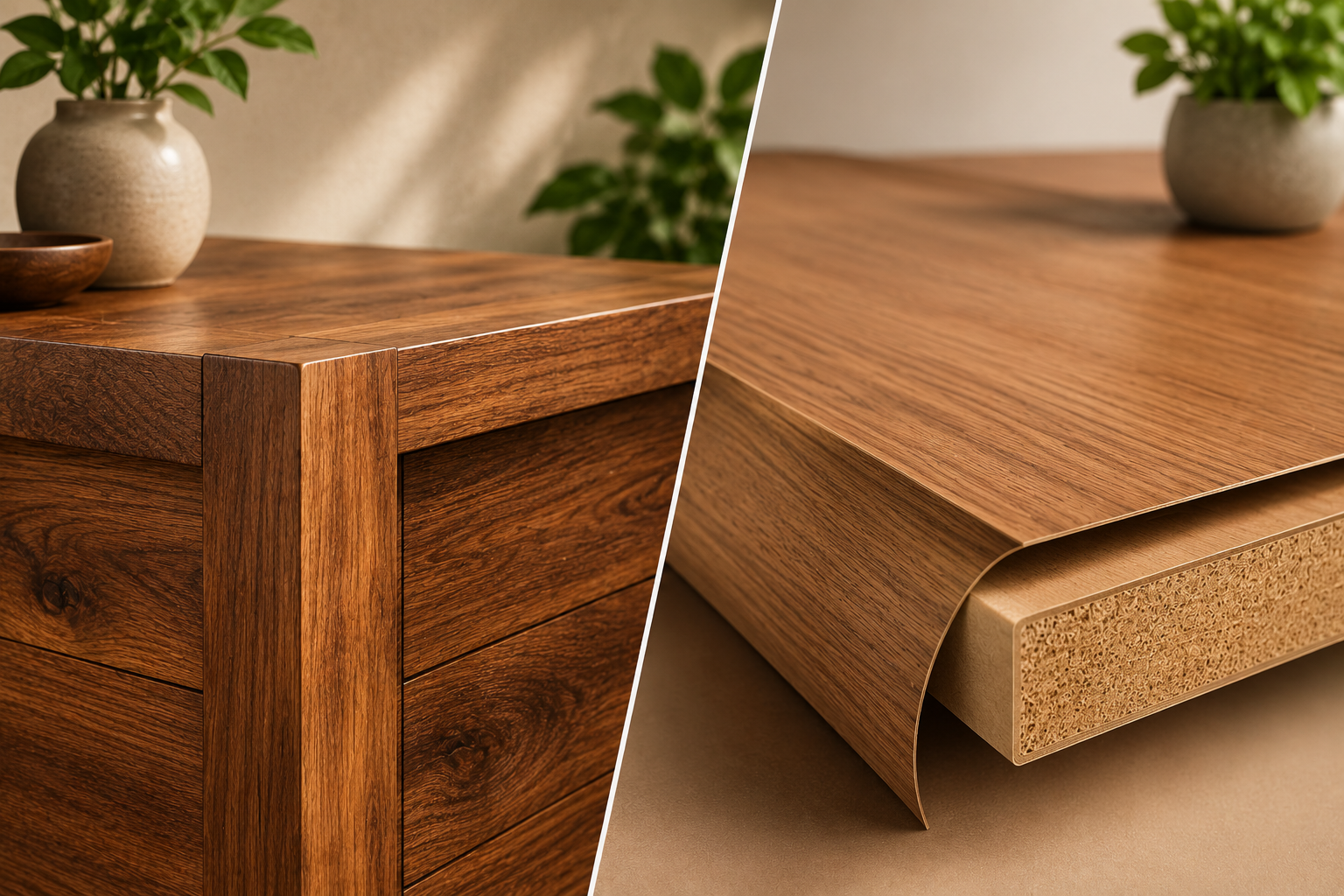
A wood veneer is a thin slice of genuine hardwood bonded to a stable core, often plywood or MDF. It isn't plastic. It isn't printed wood grain. It's real wood, just used differently.
Solid wood, on the other hand, is exactly what it sounds like. The visible boards and structural parts are cut from lumber without a manufactured core.
That distinction changes almost everything about performance.
Years ago I assumed veneer was simply the cheaper shortcut manufacturers used to cut costs. Then I visited a local cabinet shop.
Large conference tables? Veneer.
High-end executive desks? Veneer.
Museum-quality cabinetry? Also veneer.
That caught me off guard.
Professional woodworkers often choose veneer because certain projects actually benefit from its stability.
Wood moves. A lot more than people realize.
Here's something furniture stores rarely explain.
Wood constantly expands and contracts as humidity changes. Even after it's been cut, dried, sanded, and finished, it still reacts to moisture in the surrounding air.
That's completely natural.
Solid wood tabletops can grow slightly wider during humid seasons and shrink again when indoor air becomes dry. Furniture makers account for this movement through specialized joinery and construction methods.
Ignore that movement, and cracks eventually appear.
Engineered wood beneath veneer behaves differently. Because its layers are arranged in opposing directions, expansion becomes much more controlled.
That's one reason large cabinet doors and wide tabletops are often built using veneered panels rather than massive solid boards.
Less seasonal drama.
Why solid wood still earns its reputation
There is something satisfying about lifting a genuine hardwood chair.
The weight. The grain. The tiny imperfections.
Solid wood develops character over time that many people genuinely appreciate. Small dents, subtle color changes from sunlight, and gentle wear often become part of the furniture's story instead of looking like damage.
Another advantage is repairability.
Deep scratches can often be sanded away because the wood extends all the way through the surface. Refinishing is usually possible multiple times during the furniture's lifetime.
That's difficult to beat.
Families sometimes pass solid wood furniture from one generation to the next for exactly this reason. Properly maintained, quality hardwood pieces can remain functional for decades.
Even longer.
Veneer has strengths most buyers overlook
I wasn't expecting this.
Some veneer furniture actually solved problems I'd experienced with solid wood.
Take wide dining tables.
A single slab of solid hardwood that spans several feet becomes increasingly vulnerable to seasonal movement. Veneered construction allows manufacturers to create large, flat surfaces that remain more dimensionally stable.
The appearance can be exceptional because the visible surface is still genuine hardwood.
Manufacturers also have more creative freedom.
Book-matched walnut grain.
Complex geometric patterns.
Continuous grain flowing across multiple cabinet doors.
Many of these visual effects would be incredibly expensive—or practically impossible—to achieve using only thick solid boards.
Cost isn't the whole story
Price matters.
Nobody denies that.
Still, the cheapest option isn't always veneer, and the most expensive piece isn't automatically superior.
A well-built veneered cabinet using quality plywood may outperform a poorly constructed solid wood cabinet assembled with inferior joinery.
Construction matters just as much as material.
Whenever I inspect furniture now, I pay attention to:
Drawer slides and hardware quality
Joinery instead of just surface appearance
Back panels and internal construction
Thickness of components
Manufacturer reputation
Those details often predict longevity better than the words "solid wood" printed on a product label.
The moisture question
Bathrooms.
Kitchens.
Coastal homes.
These environments deserve extra thought.
Solid wood tolerates moisture reasonably well if properly finished, but repeated humidity swings can encourage warping or splitting over many years.
Quality veneer over stable engineered cores often handles changing humidity surprisingly well because the core resists movement.
There's a catch, though.
If water penetrates damaged veneer edges or poorly sealed joints, swelling beneath the surface can become difficult to repair.
Standing water is bad news for either material.
Simple as that.
Here's where veneer can disappoint
Not every veneer product deserves praise.
Some inexpensive furniture uses extremely thin veneer over low-density particleboard. Once that delicate surface chips through normal wear, repairs become challenging.
You can't simply sand deeply without risking exposure of the substrate underneath.
Edge damage is another concern.
I've seen bargain coffee tables where children bumped toys against corners, leaving small chips that exposed the core material beneath. Those defects stood out immediately.
Quality matters enormously.
Premium veneer furniture and budget flat-pack furniture should never be treated as the same category simply because both use veneer somewhere in their construction.
A quick reality check about scratches
People often ask which surface scratches more easily.
Honestly?
It depends more on the wood species and finish than the construction method.
Hard maple resists dents differently than pine.
Oak behaves differently than walnut.
A durable commercial finish often protects better than a softer oil finish regardless of whether the top layer covers solid lumber or engineered wood.
The material underneath only becomes relevant once damage reaches deeper levels.
How I decide now
My thinking changed completely.
Instead of asking, "Solid wood or veneer?"
I ask different questions.
Will this piece stay in one place for years, or will it move frequently?
Is long-term refinishing something I'll realistically do?
Does this furniture live in a humid environment?
Am I paying for craftsmanship or just marketing?
Those answers usually point toward the better purchase.
Not the label.
Signs of well-made furniture
You don't need professional woodworking experience.
Just slow down for five minutes before buying.
Open every drawer.
Check whether cabinet doors align evenly.
Look underneath the tabletop.
Feel the edges.
Ask what material forms the core if veneer is used. Reputable manufacturers generally answer without hesitation because quality construction isn't something they're trying to hide.
Solid wood furniture should also allow for natural expansion. Tight joints that completely prevent movement can become future trouble spots.
Common buying mistakes I almost made
I nearly bought furniture based entirely on appearance.
That would've been expensive.
Another mistake is assuming all engineered wood is identical. High-quality plywood differs dramatically from inexpensive particleboard in strength, durability, and moisture resistance.
Marketing language creates confusion too.
"Plywood core."
"Engineered hardwood."
"Furniture board."
These terms sound similar but can describe very different products.
Reading the specifications instead of relying on showroom signs saved me from purchasing something that didn't actually fit my needs.
Which one would I choose?
This answer surprised even me.
For heirloom dining tables, bedroom furniture meant to last generations, or handcrafted statement pieces, I'd happily invest in quality solid hardwood.
For kitchen cabinetry, entertainment centers, large desks, bookshelves, or wide furniture requiring dimensional stability, I'd have no hesitation choosing well-made veneer over a quality plywood core.
I'd avoid poorly built furniture regardless of which material headline appears on the sales tag.
That's become my rule.
Frequently Asked Questions
Is solid wood always better than veneer?
No. Solid wood offers excellent durability and refinishing potential, but quality veneer can provide greater dimensional stability, especially on large panels. Construction quality is often more important than material alone.
Can veneer furniture last for decades?
Absolutely. High-quality veneer furniture built over durable plywood cores has remained in homes, offices, and institutions for many decades with proper care.
Is veneer made from real wood?
Yes. Wood veneer is a thin slice of genuine hardwood attached to a supporting core. It should not be confused with laminate, which is a manufactured decorative surface rather than natural wood.
Which option is easier to repair?
Solid wood generally wins. Scratches and dents can often be sanded and refinished multiple times. Veneer repairs are possible but become more difficult if damage cuts through the wood layer.
What should I avoid while shopping?
Be cautious of furniture with very thin veneer over low-quality particleboard, vague material descriptions, poorly aligned drawers, loose joints, or manufacturers unwilling to explain how the piece is constructed.
My biggest takeaway
The smartest furniture purchase isn't determined by a single phrase on a product tag.
Look beyond "solid wood" or "veneer." Examine how the piece is built, think about the room where it'll live, and be honest about how you'll actually use it. A carefully constructed piece matched to your lifestyle will almost always outlast an impressive marketing claim—and you'll probably appreciate it even more five or ten years down the road.
solid wood furniture
veneer furniture comparison
wood furniture buying
durable furniture materials
furniture material guide
Found this helpful? Share it!